Complex Care at Home — Specialist Support for High-Level Needs.
Some individuals need a level of care that goes significantly beyond standard home care — whether due to a progressive neurological condition, multiple co-existing health needs, or a complex medical situation. Beryl Healthcare provides specialist complex care that is rigorous, consistent, and delivered by carers with the appropriate training and experience.
Specialist Trained Carers · Clinical Team Coordination · CQC Registered Provider

The Service Explained
What Makes Care Complex — and Why It Matters at Home
Complex care refers to support that requires a higher level of clinical knowledge, specialist training, and coordinated delivery than standard home care can offer. This may involve managing clinical equipment such as a syringe driver, PEG feeding tube, or tracheostomy; supporting someone through a rapidly deteriorating condition; or providing care for an individual with multiple, intersecting health needs that require a precisely coordinated approach.
The reason this matters is that complex care in a home environment is only safe and effective when the carer has the right training, the care plan is built around clinical requirements as well as personal preferences, and communication with the wider healthcare team is consistent and reliable.
At Beryl Healthcare, we do not attempt complex care beyond the competency of our carers. Every complex care placement is assessed individually, training is confirmed before care begins, and we maintain close liaison with the relevant clinical teams throughout. Our commitment is to do complex care properly — or to be honest about the limits of what we can safely provide.
"Complex care done well keeps people at home who would otherwise be in hospital. That is what we are here to make possible."
What We Can Provide
What Our Complex Care Can Include
The specific elements of complex care that Beryl can provide are determined on a case-by-case basis, subject to individual assessment and confirmed carer competency. Not all elements listed are available in all circumstances.
Advanced personal care — skilled support with all aspects of intimate care
Syringe driver support — monitoring and reporting alongside clinical oversight
PEG and enteral feeding support — trained management within agreed protocols
Catheter care — ongoing management and monitoring of urinary catheters
Stoma care — skilled support with colostomy and other stoma management
Tracheostomy care — trained support subject to clinical assessment
Epilepsy management — trained seizure response and medication administration
Ventilator support — trained assistance subject to clinical verification
Complex medication regimes — high-frequency or clinically sensitive schedules
Pressure care — advanced repositioning protocols and wound monitoring
Liaison with specialist clinical teams — nurses, therapists, and consultants
Full care documentation — accurate, contemporaneous records for clinical review
Is This Right for Your Family?
Who Complex Care Is For
Complex care is appropriate for adults whose care needs go beyond what standard home care can safely address. This includes individuals living with acquired brain injury, advanced motor neurone disease, late-stage multiple sclerosis, Duchenne muscular dystrophy, or other progressive neurological conditions. It is also the right option for those who have experienced a severe stroke or traumatic injury and require sustained, clinically informed care at home rather than a residential placement.
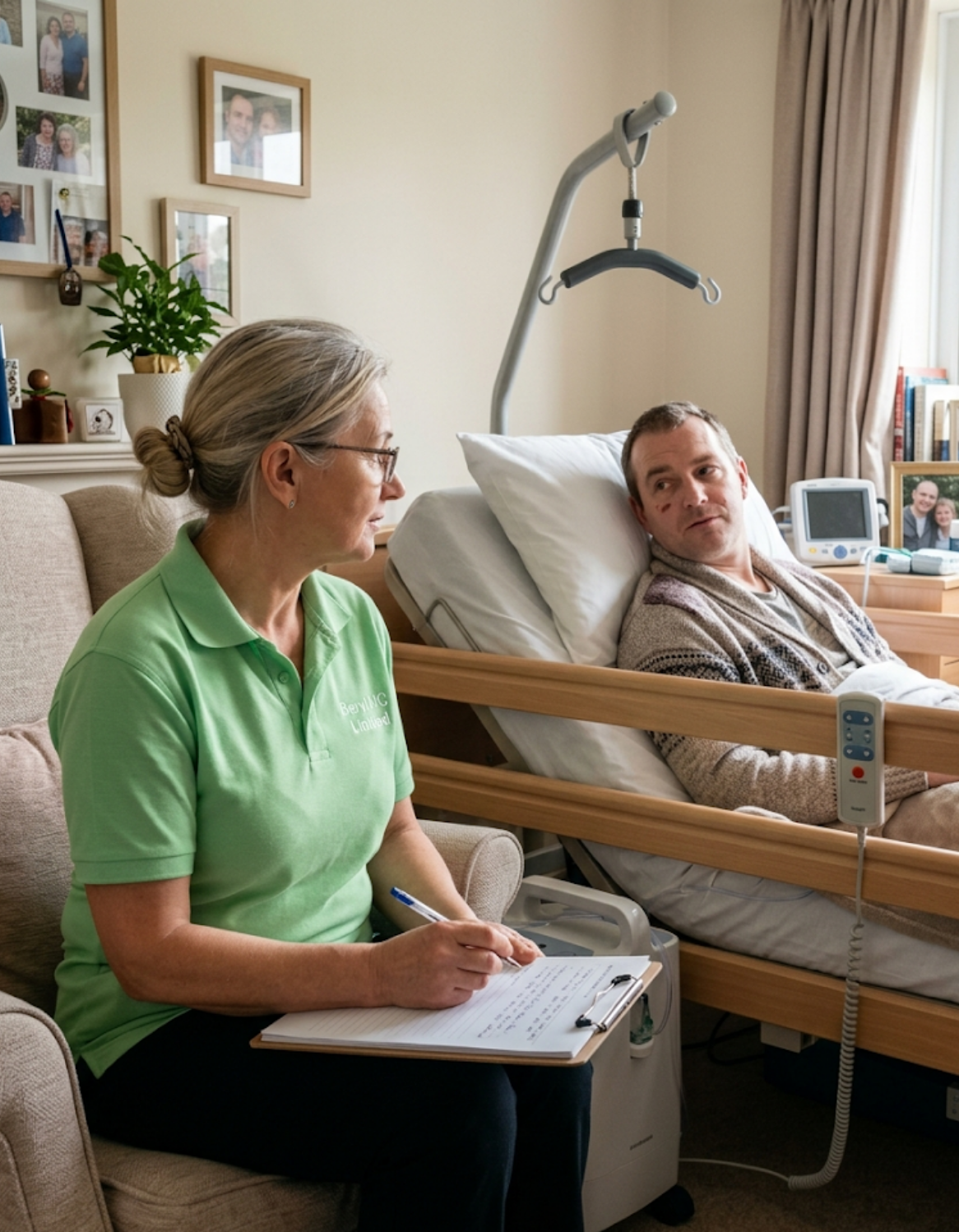
Families who have been caring for a loved one in hospital and are working to facilitate a home discharge will often find that complex care is the bridge that makes that transition possible. We work with discharge planners, specialist nurses, and occupational therapists to ensure that the home environment and the care plan are both ready before the individual comes home.
We are also able to support individuals with complex needs who are already at home but whose current care arrangement is not meeting their needs safely or consistently.
How We Work
How We Approach Complex Care
Complex care requires a level of operational rigour that goes beyond standard care management. These are the four commitments that underpin every complex care placement we make.
Competency First
We confirm the training and competency of every carer before they begin a complex care placement. If the competency is not there, we say so — and we work to address it or find a carer who already has it.
Clinical Liaison
We maintain active communication with the individual's GP, specialist nurses, community nursing team, and any other clinical professionals involved. Care plans are built with clinical input, not alongside it as an afterthought.
Sile's Direct Oversight
Sile is personally involved in every complex care assessment and remains in oversight throughout the placement. Complex care is not delegated to coordinators — it is managed at the highest level of our organisation.
Honest Limits
We are explicit about what we can and cannot safely do. If the clinical requirements of a complex care situation exceed what we can provide with confidence, we will say so clearly and work to identify the right solution.
Specialist care at home is not a compromise. In the right hands, it is the best possible option.
When complex care is delivered by carers who are properly trained, clinically supported, and working to a plan built around the individual — it enables people to live at home who would otherwise face a hospital bed or a residential placement. That is not second best. For the people we support, it is everything.
Working with Your Clinical Team
We Work Alongside Your Healthcare Team
Complex care at home does not replace clinical care — it supports it. At Beryl Healthcare, we position ourselves as an active partner in the broader clinical team around the individual. We contribute accurate, timely care records, flag changes promptly, and participate in reviews and handovers as required.
We have experience working alongside GPs, community nurses, specialist palliative care nurses, respiratory physiotherapists, speech and language therapists, dietitians, and hospital-based specialist teams. If you are a clinical professional arranging a complex care discharge, please contact us directly — we are used to working at pace and to clinical standards of documentation.
General Practitioners
Community and District Nurses
Specialist Palliative Care Nurses
Respiratory Physiotherapists
Hospital Discharge Coordinators
Specialist Consultant Teams
Common Questions
Frequently Asked Questions
Ready to Discuss Complex Care?
Whether you are a family member researching options or a clinical professional arranging a discharge, our team is ready to have an informed, detailed conversation. Please call or send an enquiry — we respond to complex care enquiries as a priority.
Clinical Professionals
If you are a GP, nurse, discharge coordinator, or other healthcare professional, please call our team directly on [NUMBER] and ask to speak with a senior care manager. We are used to working at clinical pace and to clinical standards.